Dual core: Difference between revisions
| (8 intermediate revisions by the same user not shown) | |||
| Line 2: | Line 2: | ||
== Mechanism == | == Mechanism == | ||
Generally, the first sleep is taken around dusk (i.e. starting ~19-23) to take advantage of increased likelihood of slow-wave sleep (SWS) due to melatonin secretion around this time, meanwhile the second sleep is generally taken around dawn (i.e. starting ~4-8) to take advantage of increased likelihood of rapid eye movement (REM) sleep<ref | Generally, the first sleep is taken around dusk (i.e. starting ~19-23) to take advantage of increased likelihood of slow-wave sleep (SWS) due to melatonin secretion around this time, meanwhile the second sleep is generally taken around dawn (i.e. starting ~4-8) to take advantage of increased likelihood of rapid eye movement (REM) sleep.<ref name="Feinberg" /><ref name="Franz" /><ref name="Wallace" /> | ||
Some individuals may be natural [[segmented]], [[siesta]], or [[DC1]] sleepers, given that an individual's sleep may become bifurcated when undisturbed<ref | Some individuals may be natural [[segmented]], [[siesta]], or [[DC1]] sleepers, given that an individual's sleep may become bifurcated when undisturbed<ref name="Wehr" />, particularly with a lack of artificial lighting during the evening, and that non-industrial societies<ref name="Gandhi" /><ref name="Ekirch" /> or non-electric societies<ref name="Samson" /> tend to have a biphasic sleeping pattern with an elective nap in the afternoon. | ||
The core length on the standard dual core schedules often isn't a multiple of 1.5h. It was suggested that sleep cycles are compressed/lengthened in this case.<ref | The core length on the standard dual core schedules often isn't a multiple of 1.5h. It was suggested that sleep cycles are compressed/lengthened in this case.<ref name="polynet" /> | ||
== | == Alternative mechanism == | ||
Segmented and siesta, along with [[E1|Everyman 1]] (a single core sleep schedule), tend to have high success rates within the polyphasic community.<ref | {{Alternative Hypothesis}} | ||
It was noticed by some polyphasic community members that a longer core length, which is not a multiple of 1.5h, did not lead to the cycle lengthening on dual core schedules in some cases. This is mostly applicable to the standard Segmented and DC1 schedules. | |||
=== Core 1 === | |||
The first core on the standard Segmented is 3.5 hours, and 3.3 hours on DC1. The additional 20-30 minutes often are added to [[cores]] for getting more [[wikipedia:Non-rapid_eye_movement_sleep|NREM2]] or [[wikipedia:Rapid_eye_movement_sleep|REM]] sleep. In this case, sometimes the core has a normal structure with the standard sleep cycles length. Some additional light sleep is inserted after the second core, which makes waking up and staying awake easier. | |||
=== Core 2 === | |||
According to the [[EEG]] readings of some community members, the second core on dual core schedules often starts with [[SOREM]], following by a regular non-lengthened sleep cycle. This is also a possible reason why Segmented sleep is a viable schedule despite having fewer cycles. In fact, it might have a regular number of the REM episodes, considering SOREM in the second core is the fifth one. | |||
=== Examples === | |||
<gallery> | |||
File:20201217072015!phpEhCzvJ.png|Segmented-shortened, Zeo EEG. The first core has additional light sleep in the end; the second core starts with SOREM. | |||
File:MostlySmart DC4 cut.png|MostlySmart, DC4, Zeo EEG. SOREM in the second core. | |||
File:segmented eeg.png|Segmented-recovery, Zeo EEG. Additional light sleep in the end of core 1; SOREM in core 2. | |||
</gallery> | |||
== Schedules == | |||
Segmented and siesta, along with [[E1|Everyman 1]] (a single core sleep schedule), tend to have high success rates within the polyphasic community.<ref name="polysurvey" /> | |||
=== Segmented === | === Segmented === | ||
| Line 37: | Line 54: | ||
[[DC4|Dual core 4]], usually denoted as DC4, has two short cores at night and four naps. The total sleep time of DC4 is generally 4h20m. This schedule is often used as a means for gradual adaptation to Uberman, but so far no successful attempts has been known with this approach. | [[DC4|Dual core 4]], usually denoted as DC4, has two short cores at night and four naps. The total sleep time of DC4 is generally 4h20m. This schedule is often used as a means for gradual adaptation to Uberman, but so far no successful attempts has been known with this approach. | ||
=== | === Ducamayl === | ||
[[File: | [[File:Ducamayl from DC2-Mod.png|thumb|A possible Ducamayl variant]] | ||
[[ | [[Ducamayl]], an acronym for "dual core as much as you like", is a variant of [[Spamayl]] that includes two core sleeps, generally at dusk and dawn. The idea is to adapt to a general dual core sleep schedule, one in which the individual learns the flexibility to move around start & end times of their cores & nap(s). The total sleep varies broadly, though is generally 5h30m to 7h. | ||
=== Bimaxion === | === Bimaxion === | ||
| Line 45: | Line 62: | ||
[[Bimaxion]] is a strict schedule that combines elements of DC2 and [[Dymaxion]] (an experimental nap-only schedule), designed as a transitional schedule with Dymaxion in mind. The total sleep time is 4h. | [[Bimaxion]] is a strict schedule that combines elements of DC2 and [[Dymaxion]] (an experimental nap-only schedule), designed as a transitional schedule with Dymaxion in mind. The total sleep time is 4h. | ||
== | == References == | ||
{{ | {{reflist|refs= | ||
<ref name="Feinberg">{{cite journal |vauthors=Feinberg I, Floyd TC |date=1979 |title=Systematic trends across the night in human sleep cycles |journal=Psychophysiology |volume=16 |issue=3 |pages=283-291}}</ref> | |||
<ref name="Franz">{{cite journal |vauthors=Franz W |date=2017 |title=Modeling the mammalian sleep cycle |journal=Current opinion in neurobiology |volume=46 |pages=68-75}}</ref> | |||
=== | <ref name="Wallace">{{cite journal |vauthors=Wallace CD |date=2009 |title=A biphasic daily pattern of slow wave activity during a two-day 90 minute sleep wake schedule |journal=Archives italiennes de biologie |volume=147 |issue=4 |pages=117-130}}</ref> | ||
<ref name="Wehr">{{cite journal |vauthors=Wehr TA |date=1992 |title=In short photoperiods, human sleep is biphasic |journal=Journal of Sleep Research |volume=1 |issue=2 |pages=103-107}}</ref> | |||
<ref name="Gandhi">{{cite journal |vauthors=Gandhi Y |date=2015 |title=Natural sleep and its seasonal variations in three pre-industrial societies |journal=Current Biology |volume=25 |issue=21 |pages=2862-2868}}</ref> | |||
<ref name="Ekirch">{{cite journal |vauthors=Ekirch AR |date=2016 |title=Segmented sleep in preindustrial societies |pages=715-716}}</ref> | |||
<ref name="Samson">{{cite journal |vauthors=Samson DR |date=2017 |title=Segmented sleep in a nonelectric, small‐scale agricultural society in Madagascar |journal=American Journal of Human Biology |volume=29 |issue=4}}</ref> | |||
<ref name="polynet">{{cite web |url=https://web.archive.org/web/20201125214204/https://www.polyphasic.net/sleep-mechanics/polyphasic-sleep-adaptation/ |title=Polyphasic Sleep & Adaptation |website=polyphasic.net |access-date=2020-12-17}}</ref> | |||
<ref name="polysurvey">{{cite web |url=https://youtu.be/BA24s8KwBi0 |title=Polyphasic Survey Results and Analysis |date=2018 |website=YouTube}}</ref> | |||
}} | |||
{{TNT|Polyphasic Sleep Schedules}} | |||
[[Category:Schedules]] | [[Category:Schedules]] | ||
Latest revision as of 00:40, 25 May 2025
A dual core schedule is simply a sleep schedule with two core sleeps and zero or more naps.
Mechanism
Generally, the first sleep is taken around dusk (i.e. starting ~19-23) to take advantage of increased likelihood of slow-wave sleep (SWS) due to melatonin secretion around this time, meanwhile the second sleep is generally taken around dawn (i.e. starting ~4-8) to take advantage of increased likelihood of rapid eye movement (REM) sleep.[1][2][3]
Some individuals may be natural segmented, siesta, or DC1 sleepers, given that an individual's sleep may become bifurcated when undisturbed[4], particularly with a lack of artificial lighting during the evening, and that non-industrial societies[5][6] or non-electric societies[7] tend to have a biphasic sleeping pattern with an elective nap in the afternoon.
The core length on the standard dual core schedules often isn't a multiple of 1.5h. It was suggested that sleep cycles are compressed/lengthened in this case.[8]
Alternative mechanism
It was noticed by some polyphasic community members that a longer core length, which is not a multiple of 1.5h, did not lead to the cycle lengthening on dual core schedules in some cases. This is mostly applicable to the standard Segmented and DC1 schedules.
Core 1
The first core on the standard Segmented is 3.5 hours, and 3.3 hours on DC1. The additional 20-30 minutes often are added to cores for getting more NREM2 or REM sleep. In this case, sometimes the core has a normal structure with the standard sleep cycles length. Some additional light sleep is inserted after the second core, which makes waking up and staying awake easier.
Core 2
According to the EEG readings of some community members, the second core on dual core schedules often starts with SOREM, following by a regular non-lengthened sleep cycle. This is also a possible reason why Segmented sleep is a viable schedule despite having fewer cycles. In fact, it might have a regular number of the REM episodes, considering SOREM in the second core is the fifth one.
Examples
-
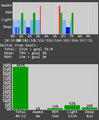 Segmented-shortened, Zeo EEG. The first core has additional light sleep in the end; the second core starts with SOREM.
 -
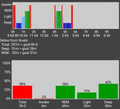 MostlySmart, DC4, Zeo EEG. SOREM in the second core.
 -
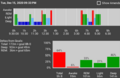 Segmented-recovery, Zeo EEG. Additional light sleep in the end of core 1; SOREM in core 2.


Schedules
Segmented and siesta, along with Everyman 1 (a single core sleep schedule), tend to have high success rates within the polyphasic community.[9]
Segmented

Segmented sleep, sometimes denoted as DC0 (dual core with zero naps), has one core sleep generally around dusk and one core sleep generally around dawn a few hours after the end of the dusk core. Segmented sleep tends to have around 6-8 hours of total sleep time.
Siesta

Siesta sleep generally consists of a long core at night and a shorter core (siesta nap) midday. Siesta sleep tends to have around 6-8 hours of total sleep time.
Since Siesta depends on a different mechanism than the more relatively standard dual core schedules like Segmented or DC1, it may be contended whether Siesta is a dual core schedule.
Dual core 1

Dual core 1, usually denoted as DC1, has a nap in addition to the two cores. This nap allows polyphasic enthusiasts to decrease total sleep time. A sustainable DC1 schedule tends to have 5h20m-7h total sleep time.
Dual core 2

Dual core 2, usually denoted as DC2, is the logical successor of DC1, having one core around dusk, one core around dawn, and two naps. A sustainable DC2 tends to have 5h-5h30m total sleep time.
Dual core 3

Dual core 3, usually denoted as DC3, is the logical successor of DC1, having one short core around dusk, one short core around dawn, and three naps. The total sleep time of DC3 is generally 4h.
Dual core 4

Dual core 4, usually denoted as DC4, has two short cores at night and four naps. The total sleep time of DC4 is generally 4h20m. This schedule is often used as a means for gradual adaptation to Uberman, but so far no successful attempts has been known with this approach.
Ducamayl

Ducamayl, an acronym for "dual core as much as you like", is a variant of Spamayl that includes two core sleeps, generally at dusk and dawn. The idea is to adapt to a general dual core sleep schedule, one in which the individual learns the flexibility to move around start & end times of their cores & nap(s). The total sleep varies broadly, though is generally 5h30m to 7h.
Bimaxion

Bimaxion is a strict schedule that combines elements of DC2 and Dymaxion (an experimental nap-only schedule), designed as a transitional schedule with Dymaxion in mind. The total sleep time is 4h.
References
- ↑ Feinberg I, Floyd TC (1979). "Systematic trends across the night in human sleep cycles". Psychophysiology. 16 (3): 283–291.
- ↑ Franz W (2017). "Modeling the mammalian sleep cycle". Current opinion in neurobiology. 46: 68–75.
- ↑ Wallace CD (2009). "A biphasic daily pattern of slow wave activity during a two-day 90 minute sleep wake schedule". Archives italiennes de biologie. 147 (4): 117–130.
- ↑ Wehr TA (1992). "In short photoperiods, human sleep is biphasic". Journal of Sleep Research. 1 (2): 103–107.
- ↑ Gandhi Y (2015). "Natural sleep and its seasonal variations in three pre-industrial societies". Current Biology. 25 (21): 2862–2868.
- ↑ Ekirch AR (2016). "Segmented sleep in preindustrial societies": 715–716. Cite journal requires
|journal=(help) - ↑ Samson DR (2017). "Segmented sleep in a nonelectric, small‐scale agricultural society in Madagascar". American Journal of Human Biology. 29 (4).
- ↑ "Polyphasic Sleep & Adaptation". polyphasic.net. Retrieved 2020-12-17.
- ↑ "Polyphasic Survey Results and Analysis". YouTube. 2018.